Over the years, the Vermont Historical Society newsletter made mention of the activities of the Putney Historical Society, giving a glimpse into the PHS activities that attracted attention at the state level. A few other items of more general interest are identified below.
VHS Newsletter June 1953 Vol. 4, No. 10 – pages 75-79. The PHS participated in a display of Vermont history at Jordan Marsh department store in Boston. The article was titled “History on Parade: Jordan Marsh Co.’s Summer Street Window, Boston, Mass.” It included text and photos of a display of Vermont artifacts in the display windows at Jordan Marsh that included soapstone pipe fragments and soapstone candlesticks, provided by John Quay of Putney; hand-made brace and bit, dividers made from buggy-top hinge and balling iron provided by Norman Dort of Putney.; a hand-forged logging chain and early broad-ax provided by Norman Dort; telephones and acousticons provided by Fred Neill of Putney (the manager of the telephone switchboard); a Queen Anne musket and a painting of early travel both provided by Norman Dort of Putney.
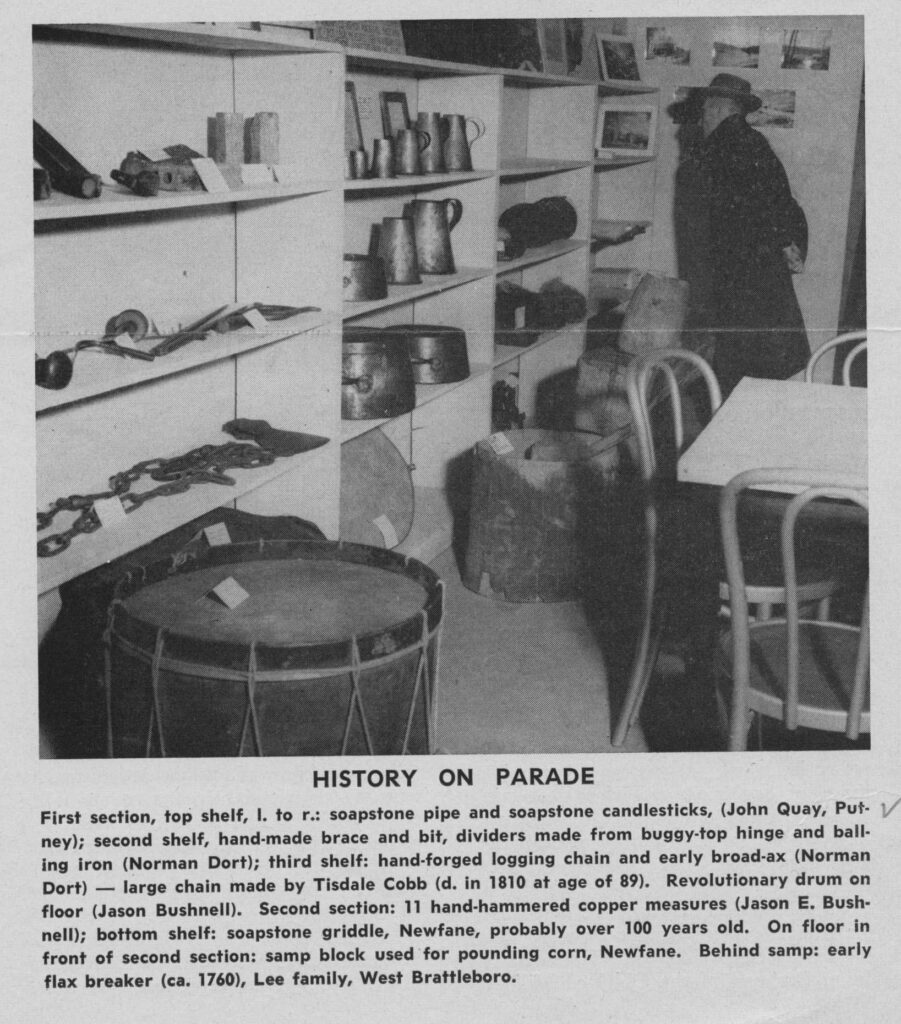
Mr. and Mrs. Philip B. Chase of Putney are acknowledged for being instrumental in gathering the pieces and arranging for them to be shipped to Boston. Mrs. Chase also provided the captions for the photographs in the article.
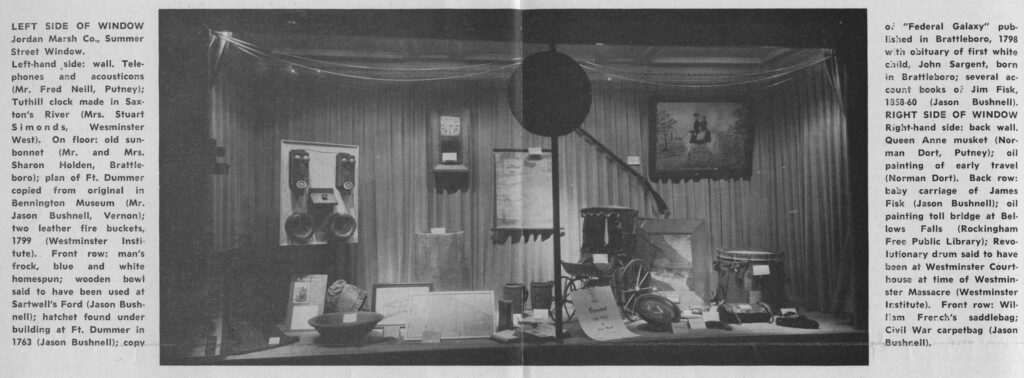
The painting in the exhibit provided by Norman Dort is described as having been painted in 1853 by Major Obed Gilman Dort to depict the mode of travel 100 years earlier. It was hung on the front of the first locomotive which entered the Keene, NH depot at the opening of the Ashuelot division of the Boston and Maine RR. The musket loaned by Norman Dort probably belonged to Samuel Cobb of Putney who died about 1790.
The calendar section of the newsletter noted the Putney 200th celebration on August 8 and 9.
VHS Newsletter January 1954, Vol. 5, Number 5 – page 35. “Congratulations to Putney: Go Thou and Do Likewise”. A story congratulating Putney on publication of the town history “Putney: 1753-1953”. The article starts with “We have learned to admire the quiet courage of small groups of women in many activities – with husbands too busy to lend them a hand – who undertake work of a cultural type, knowing that it means hard work and few rewards.” It goes on to describe the Fortnightly Club approaching the VHS for help with editing, printing and distributing the book. The format and contents are described admiringly and the authors congratulated. It ends with “Those with Putney affiliations, near or far, or those interested in town histories, may order the book through VHS at a cost of $3.”
VHS Newsletter, April 1958, Vol. 9, No. 8 – page 65. Lura Frost apparently asked VHS for information on a clover mill in Putney (likely a mill that once stood on East Putney Brook at the intersection of East Putney Falls Road and Cemetery Road). Dr. Asselin provided a response describing that clover was an important forage crop in the early 1800s, but instead of feeding cattle the seed along with the rest of the plant, farmers had the clover put through a mill to separate the seed so that it could be saved for planting the following year.
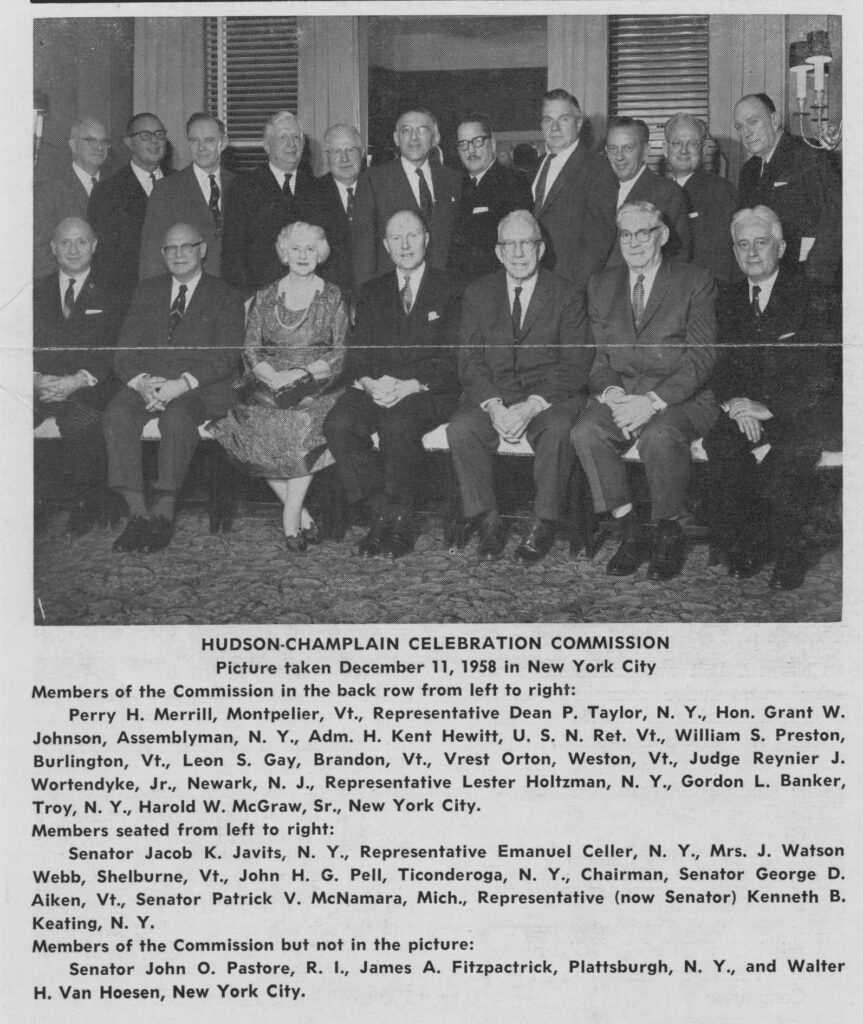
VHS Newsletter, February 1959, Vol. 10, No. 6- page 41. Senator George Aiken was shown as part of the Hudson-Champlain Celebration Commission. The commission was established to plan celebrations of the 350th anniversary of Samuel de Champlain entering Lake Champlain.
VHS Newsletter, February 1960, Vol. 11, No. 6 – page 44. “VHS is happy to learn of the founding of the Putney Historical Society with 67 founding members. There had previously been four organizational meetings. Mrs. Joseph F. Montville spoke on the use of tole ware and displayed items including a “coffin tray”, a foot tub and a “petticoat lamp”. The society is now in the process of incorporation [PHS was incorporated on September 21, 1959]. Mrs. Philip B. Chase, Chairman of the Custodial Committee for the Putney bicentennial funds unexpended in 1953, gave the new society a start by presenting it the residue from that fund. Mrs. Chase also presented a rare book written by John Humphrey Noyes, The Way of Holiness, printed in Putney 1838. Malcolm Crawford donated to the society a copy of the First Annual Report of the Onieda Association.”
“PHS reports the following officers:
President – Mrs. Everett S. Harlow
Vice President – Mrs. Philip B. Chase
Secretary – Miss Ethel B. Page
Treasurer – Mr. George H. Gassett
Directors – Mrs. George H. Gassett, D. L. Cory, Mrs. Walter Hendricks”
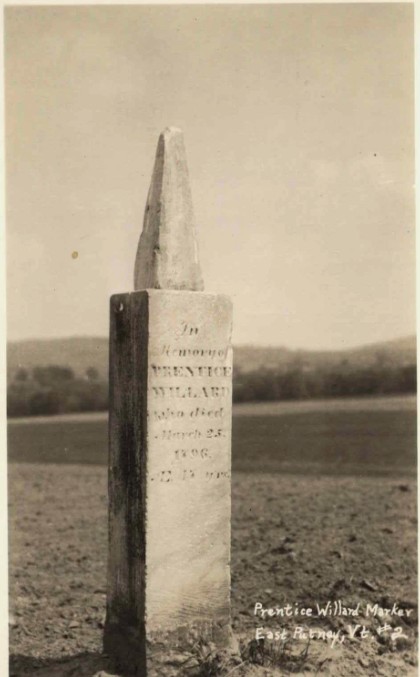
VHS Newsletter, June 1960, Vol. 11, No. 10 – page 77. PHS meeting at Currier Hall at Windham College. Inez Harlow announced that Edward Dodd is making a contour map of Putney which includes old roads, cellar holes and landmarks of the early 1800s, as well as present roads. [This is a map that is currently available for sale from the PHS.]
Mrs. Harlow described steps to relocate the Willard Monument from Putney Meadows to the East Putney Cemetery. [The monument was erected on the Great Meadows along the Connecticut River at the request of Prentice Willard who died on March 25, 1796, at the age of 47. He owned all of the Great Meadows from 1784 to 1792 when he sold it to Samuel Works of Westmorland, NH. Presumably his remains were moved at the same time as the monument.]
VHS Newsletter, November 1960, Vol. 12, No. 3 – page 22. PHS has recently joined the Vermont Old Cemetery Association. Its project has been to remove the Prentice Willard marker from the Great Meadows to the East Putney Cemetery. This marker has been rubbed by cattle and nicked by farm machinery but now its secure position in the cemetery will prevent disfigurement and it will be on view along with the other markers of early settlers in Putney.
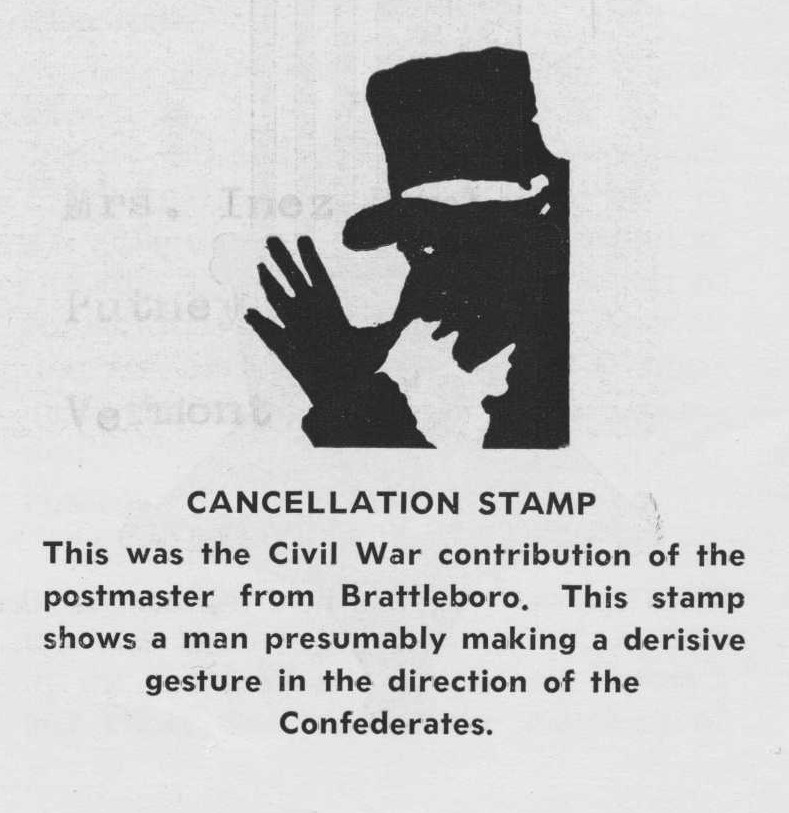
VHS Newsletter, May 1961, Vol. 12, No. 9 – page 68. PHS opened an exhibit on April 13 of records and articles relating to the participation of Putney in the Civil War. A paper on Putney’s war effort was read to the members of the Society by Mrs. Inez Harlow and Mrs. George Gassett.
On page 70 is an image that was used as a cancellation stamp during the Civil War by the post master of Brattleboro of a silhouette of a man thumbing his nose, “presumably making a derisive gesture in the direction of the Confederates”. A little local initiative.
Mrs. George Gassett gave a paper entitled “Sleeping Chambers”. She quoted state laws concerning cemeteries and then told the locations and facts about the public and private cemeteries in Putney, including that the Old North Burying Ground stones date as early as 1777 and the Kathan graveyard on the Old Depot Road is the oldest one in town.
VHS Newsletter, August 1961, Vol. 12, No. 12 – page 95. PHS held its June meeting at Currier Hall in the Windham College Building on June 29. Dr. Richard G. Wood delivered a harangue on the status of the local historical societies.
VHS Newsletter, March 1962, Vol. 13, No. 7 – page 54. PHS announces publication of “Putney Countryside” a map for walkers, riders on horseback, campers, hunters, fishermen, skiers, naturalists and historians of a section of southeastern Vermont between the Connecticut River and Grassy Brook-West River, comprising the whole township of Putney, the southern half of Westminster and the northern half of Dummerston. Historical material in Putney as of 1800 as recorded by Clifford Cory and Moncure Carpender as well as old roads, houses and cemeteries from the 1869 Beers atlas. “WARNING Roads are shifted, houses burn, are abandoned or rebuilt; a round world distorts a flat map; man’s memory is fallible; expect not exactness.”
VHS Newsletter, December 1962, Vol. 14, No. 4 – page 26. The Ranney Farm in Westminster was a recipient of one of several Vermont farms of the Century Farm plaque for farms with over a century of existence. The Ranney Farm was established in 1771 and through several generations by 1962 was a dairy farm of 160 acres.
VHS Newsletter, April 1963, Vol. 14, No. 8 – page 59. Announcement of the publication of the “Putney Countryside” map compiled by Rev. Edward Dodd. Description of the long process of obtaining the information and assuring its accuracy. Also described were various displays and events at the Central School and library. Inez Harlow presented a talk “Echoes From the Town Vault” on the results of inventorying the contents of the vault in cooperation with the Selectmen who also requested PHS supervise reconditioning and binding of one of the early town record books. Mrs. Philip B. Chase described a course she took at the Fenimore House in Cooperstown, NY on the care and preservation of old books and documents.
VHS Newsletter, July 1963, Vol. 14, No. 11 – page 82. PHS organized a weekend celebrating 10 years of progress since the Bicentennial celebration of Putney in 1953. Included in the weekend were past history of Putney, a square dance in Pierce’s Hall, a Merchant’s Carnival, chicken barbecue on the green between Route 5 and Windham College [where 802 Credit Union is currently], exhibits of historic items from the PHS collection and of former and current artists of Putney. Works of Putney authors and poets will be displayed at the Public Library, open houses at various educational institutions and old houses.
VHS Newsletter, September 1964, Vol. 16, No. 1 – page 7. Walter Hendricks was presented the Robert Frost Silver Medal at the June 1964 graduation of Windham College. The award was initiated by the Vermont Historical Society and approved by the Governor of Vermont and the state legislature. It acknowledges Hendricks’ long friendship with Frost including convincing Frost to be a trustee of Marlboro College, speaker at its first commencement, to attend the dedication of Windham College’s Pinkham Hall and to speak at Windham College commencement where Hendricks presented Frost with the Degree of Doctor of Laws.
VHS Newsletter, August 1965, Vol. 16, No. 12 – page 91. Inez Harlow and Mrs. Philip B. Chase went to Oneida, NY and talked with the Mansion House librarian about the Polly Noyes papers discovered last winter. PHS is setting up in new meeting room in the town library [in town hall]. PHS is open Tuesday and Wednesday evenings.
VHS Newsletter, September 1965, Vol. 17, No. 1 – page 6. PHS opened its historical museum on August 1. [The museum was located in the current Selectboard meeting room in Town Hall.]
VHS Newsletter, December 1965, Vol. 17, No. 4 – page 26. Inez Harlow reported the discovery of two important Noyes manuscripts in Putney. She represented the society at Plymouth [presumably for a VHS meeting]
VHS Newsletter, October 1966, Vol. 18, No. 2 – page 15. PHS held its annual meeting August 18. Lawrence Brown was elected president, Edward Dodd, Jr. VP, Miss Alice Smyth secretary, Mrs. Robert Rosegrant treasurer. Sponsored talks during summer were Prof. Charles Ratte of Windham College on Putney Geology, Anthony Kray on Rare Old US Coins, Oliver D. Vallier, librarian of the Virginia State Archaeological Society on “Indian Digging”. Exhibits included “One Hundred Years of Women’s Clothing”, “Revival of Early American Decorative Arts”, “Photographs of Putney People and Places”, and “Local Indian Artifacts”.
VHS Newsletter, January 1971, Vol. 22, No. 4. Inez Harlow talked about courses she took last summer in Cooperstown, NY.
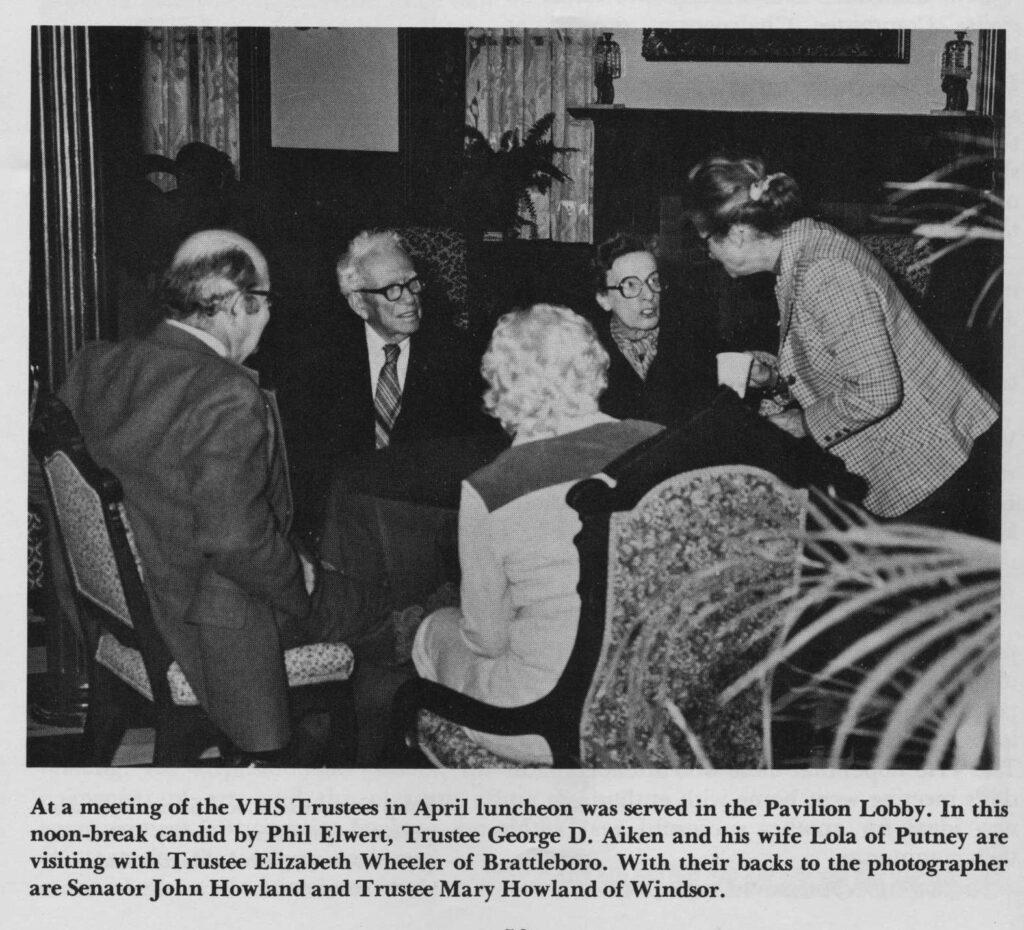
VHS Newsletter, July and August 1978, Vol. 29, No. 4 – page 59. George and Lola Aiken were shown at a meeting of VHS trustees in Montpelier.
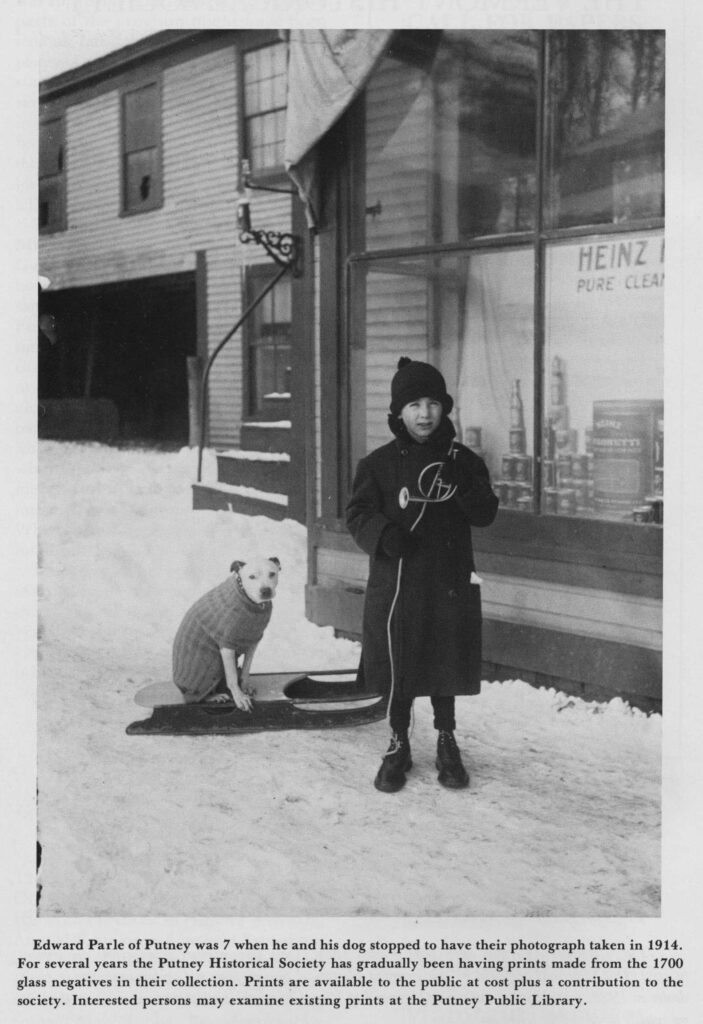
VHS Newsletter, May and June 1984, Vol. 35, No. 3 – page 54. Included is a Corser photo of boy in front of general store with dog on sled. “Edward Parle of Putney was 7 when he and his dog stopped to have their photograph taken in 1914. For several years the Putney Historical Society has gradually been having prints made from the 1700 glass negatives in their collection. Prints are available to the public at cost plus a contribution to the society. Interested persons may examine existing prints at the Putney Public Library.” [We should note that Geordie Heller did the printing and recently completed scanning the much-enlarged collection of Corser glass plate negatives in the PHS collection. We continue to make these photographs available to the public for research and personal interest.]
VHS Newsletter, July and August 1984, Vol. 35, No. 4 – page 93. A photograph from the PHS collection was included in an article titled “Village Life: 1900-1915”. The photo is by Adelbert Corser and depicts a tug of war in the street in front of the general store. [That photo was also included in a book of historic photograph by Ken Burns.]
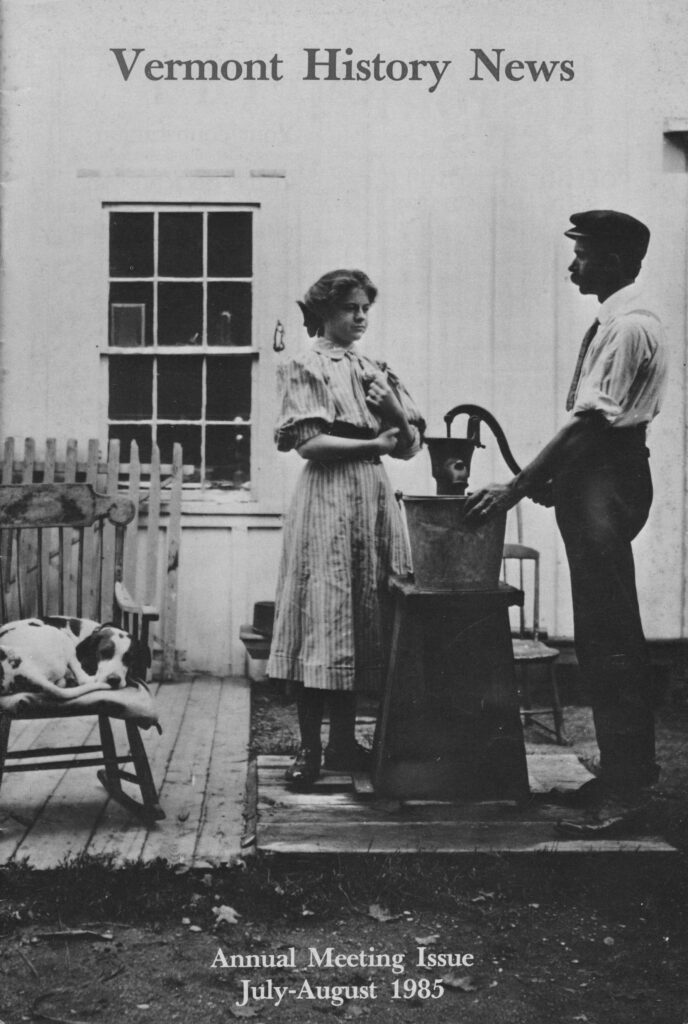
VHS Newsletter, July and August 1985, Vol. 36, No. 4 – page 73 (cover). On the cover is a Corser photo described as “A longing for a cool draught of water on a warm summer’s day is enough to bring one (or two) to the family pump just off the back stoop. The picture came from the Putney Historical Society in 1969.” The photo shows a man and a woman at a hand pump outside a house with a dog lying in a rocking chair. [The scene was at the side of the building that was the former Perfectionist Chapel on the east side of Main Street that is no longer standing.]
VHS Newsletter, September and October 1985, Vol. 36, No. 5 – page 107. Lola Aiken donated to VHS George Aiken memorabilia including Republican National Convention badges from 1940-1972, and the handmade hammer used by Gov. Aiken to damask (deface) the old Vermont State Seal in 1937.
Also in the issue is a photo of “Women workers at the W. A. Cole Paper Co., Putney. October 30, 1899 (?) from the PHS Corser glass plate collection.
VHS Newsletter, July and August 1986, Vol. 37, No. 4 – page 78. Laura Heller was nominated as trustee to the VHS.
VHS Newsletter, January and February 1988, Vol. 39, No. 1 – page 7. Included an article titled “I Believe I Will Go”: Organization Politics in Republican Vermont, Samuel B. Hand and D. Gregory Sanford.
It discussed oral histories in understanding state politics and included the following anecdote. George Aiken as a freshman state representative was able to defeat a bill sponsored by the House speaker advocating for private development of hydro power projects by scheduling the vote when he knew most of the supporters would be absent. He considered the defeat of that bill as his first step up the ladder of leadership.
As Lieutenant Governor, Aiken was interested in rural electrification. Power companies did not want to serve rural areas. In 1935, the house had adjourned and the senate was to adjourn the next day. The rural electrification program was moving ahead in Washington, but Vermont didn’t have a bill ready. One was prepared in Washington but wouldn’t arrive by train until the day the senate was set to adjourn. Aiken talked to George Davis, a member of the senate from Orleans County and asked him to move to recess the senate until the next morning. The bill arrived that night and before adjournment the next morning it was voted on and passed into law.
VHS Newsletter, January and February 1989, Vol. 40, No. 1 – page 1. The cover had a photo of a boy with a dog on a sled in front of general store in Putney, courtesy of the PHS. [Apparently this photo is a favorite of the VHS, having appeared in the VHS Newsletter in 1984.]
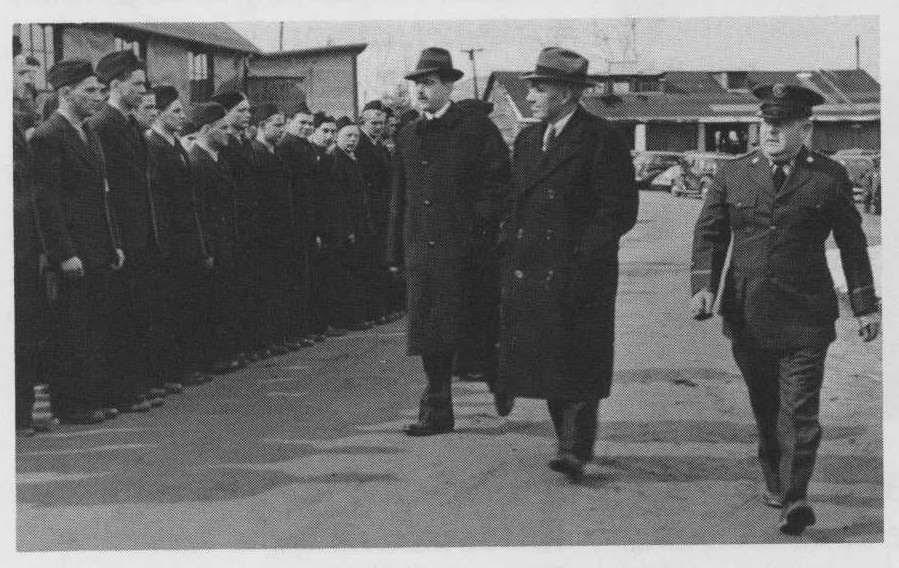
VHS Newsletter, November and December 1994, pages 74-76. An article about the Civilian Conservation Corps (CCC) in Vermont includes a photo of Governor Aiken reviewing a CCC group in Bellows Falls and mentions his help in establishing the CCC in Vermont.