Lyssa Papazian
Here is a sampling of things in the Putney Historical Society collection that are available to read, see and research.
A letter from 1842
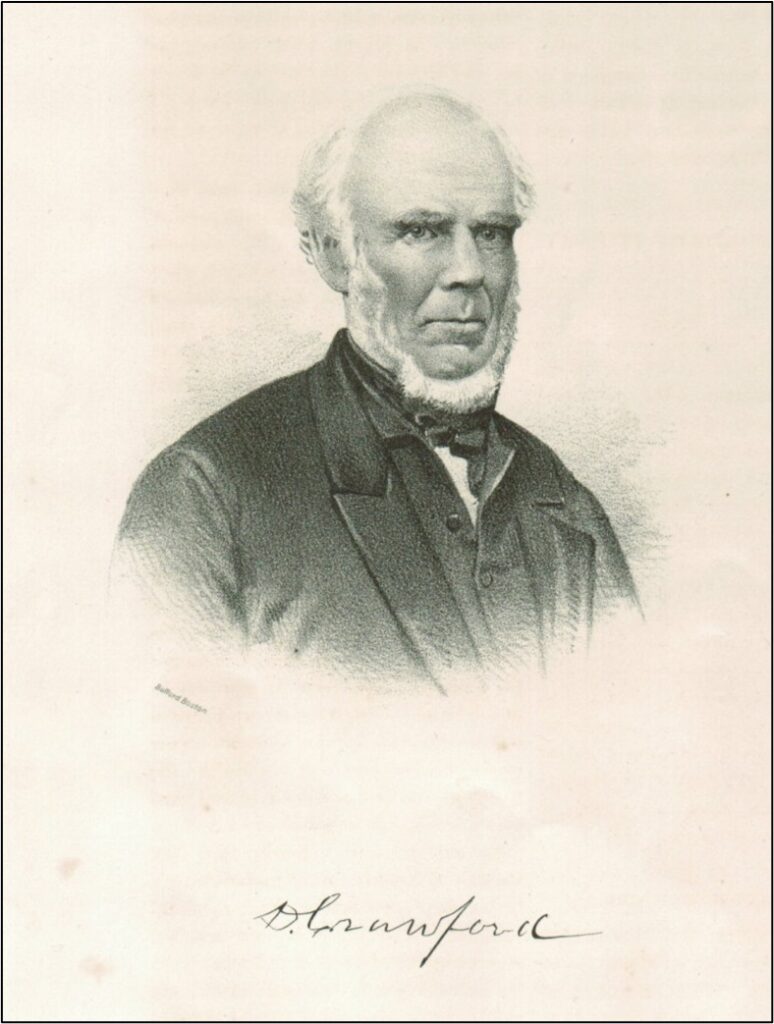
Part of a letter from David Crawford [1789-1871] of Putney, to Reverend Elisha Andrews in Armada, Michigan, formerly of Putney. Crawford, a Putney sheep farmer, also served as Justice of the Peace, Selectman, Town Representative, and Deacon of the Congregational Church. Andrews [1783-1852] had been the Congregational pastor of Putney’s second Meeting House which was dedicated in 1803 and was located on the west side of Westminster West Road just beyond Springhill Road. Reverend Andrews served there for 22 years starting in 1807, during which time a “Great Revival” occurred in the church. The Reverend moved west in the 1830s but maintained a long correspondence and business relationship with his friend David Crawford in Putney. These letters which span 1837 to 1851 are in the PHS collection and were transcribed some years ago. They tell of the state of religion, agriculture – sheep farming in particular, land speculation and news of Putney folk. They provide a wonderful window on life in Putney and the new country in a time of great change and transition. An excerpt provided here tells of the building of the third Congregational meeting house in Putney – what is now our home at Next Stage (15 Kimball Hill Road) – as well as some social issues of the day.
Putney June 1-1842
Dear Sir
Changes in the location of business have taken place since you were here – All the stores & nearly all the mechanics (?) are now down at the Village, as we call it – Several new handsome houses have been built there & the whole Village much improved – Our old Meeting house required repairs, and none below Judge White would contribute to it – The Methodists were talking about building a new house at the Village, in which nearly all these would have joined, unless we would build there – Had the Methodists have built the first house, it would have received our Congregation – Under these circumstances, all but one or two who attended at the old house, deemed it best to take done the old house & build a new – We have erected a very pretty house about opposite Mr. Grouts Store – In the basement story we have a vestry and a large school room in which we have had a Select School for nine months – The Sch. will not be continued through the summer – The Methodists are building a Meeting house on the site of the old hatter’s shop near Perry’s Tavern –
The temperance cause has made great advances in this place as well as abroad –
We have had two stores which sold spirit until last winter, when the cause of temperance was taken up by drinkers – Temperance men aided & encouraged & the work went forward. .. funds were raised & everything spirituous at the stores was purchased. – That which was fit to be used medicinally was placed in the care of the physician & the remainder destroyed – We have two taverns which sell it, but their sales are curtailed – A number of “hard cases” were reclaimed – Wm Wilder was one of the leaders. I believe he will keep his pledge – he has gone to work –
…. I am dear sir yours, etc.
David Crawford
A Brief Glimpse of a Hill Farm in Putney in September 1861
This excerpt is from a typed transcription of William C. Bacon’s 1861-1868 diary. It was transcribed by a descendant, Marjorie Bacon, probably in the 1950’s. The Bacon family lived on West Hill not far from the West Hill Cemetery where several members of the family are buried. In 1861 the family consisted of: William Cummings Bacon, aged 56; his wife Maria Mary (Blaisdell), aged 41; father Abner Bacon, aged 92; his mother Katherine (Reed) Bacon, aged 88; his children: Jennie, aged 17, Henry , aged 16, George, aged 14, and twin sisters, Ella and Emma, almost 12.
According to a 1914 multi-volume genealogy of New England Families: “William Cummings son of Abner Bacon was born at Putney Vermont August 11 1804 died there December 10 1869 He received a public school education in his native town and learned the trade of carpenter He located in Haverhill New Hampshire for a time but returned to Putney and followed his trade and farming. He attended the Baptist church and was chorister He played the bass viol in the church for many years. He served the town as road commissioner and on the school board He married Maria Mary Blaisdell who was born in Canaan New Hampshire January 25 1820 died at Bellows Falls Vermont October 27 1899 daughter of Joshua and Polly Blaisdell.”
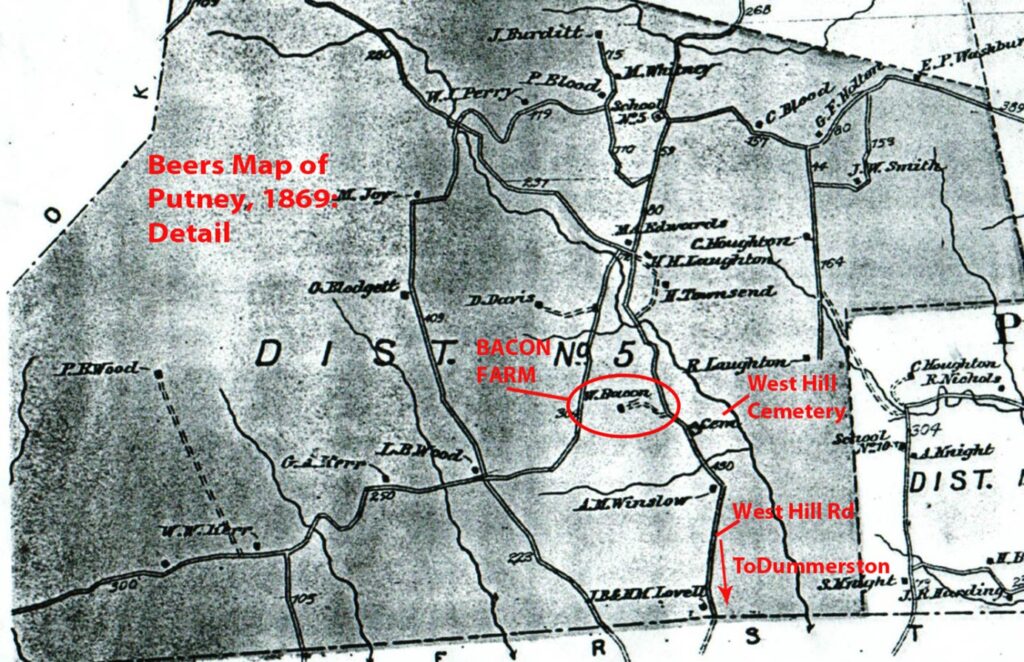
September (1861)
1 Sund this day fine fair + cool wind Doct Allen here to day M went down to Curtis
2 M Henry help wash I went down street got colt forward shoes set paid 25 cts for it and mend chair carry little stove down to doctor Allen
3 Tus get some stuff out of the yard town meeting to day choose Representative + other county officers carry Jane down to Doctor Allen to school
4 W I mowed some clover to day Boy draw some dirt and muck in the yard very cool wind
5 Th Boys + I wheel barrow out muck in swamp Shattuck paid to me 30 dolls of school money Uncle Sim + wife up to day to see father + mother
6 F went over to C Bloods this morn Henry dont doo any thing to day George + I work muck some after noon Tomas Joy here gave his ½ B corn pork cheese a coat + pr shoes half worn out Foggy morn fair P M Doctor here to day
7 Sat George + I dug muck to day what we did doo Henry went down after Jane this morn then he help was the rest of the day went out jest at night catch some fishes
8 Sund this has been a fair pleasant day Henry go meeting Mrs Winslow up to day Got a letter from Asa Caroline Clark + Lydy stop
9 M Doctor here today to mother Henry carry Jane down P. M. to school George + I plow some in upper orchard
10 T Boys + I work up round upper barnyard fix fence posts + draw 4 load dirt in yard
11 W this has been a rainy day quite a wet time Doctor here this morn to mother Boy sift grass seed I put rockers on fathers chair”
A Putney Inventor – Israel Keyes
The original 1839 patent letter for Israel Keyes’ invention of a grain rake is in our collection.
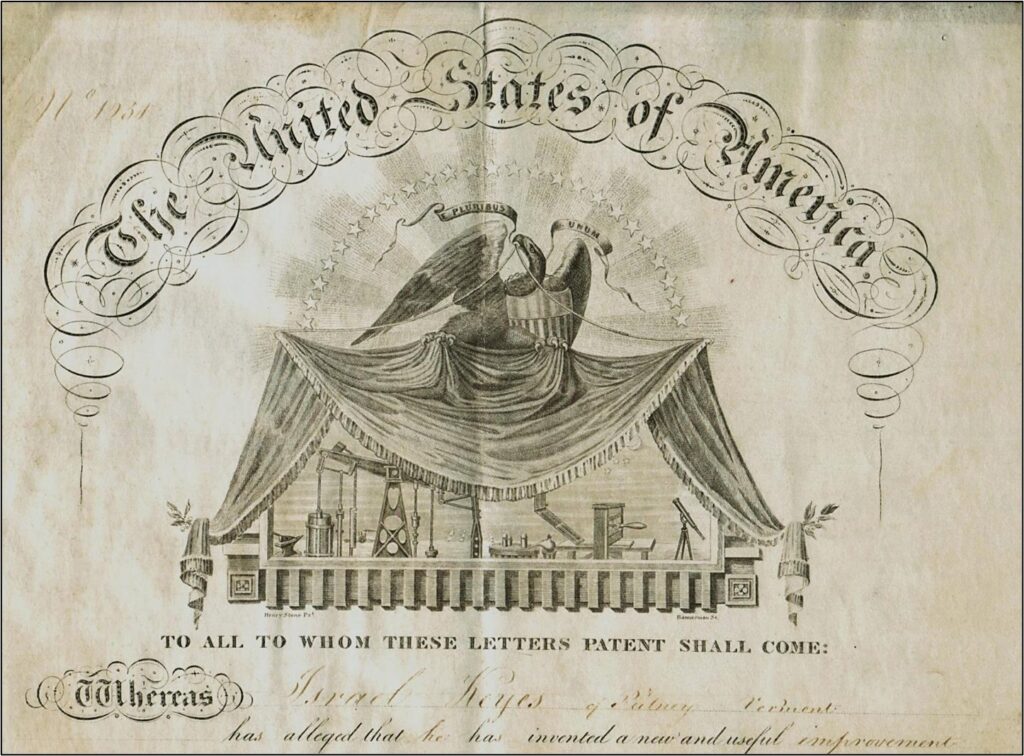
About the inventor – from the People of Putney (1953):
“Israel [Keyes] remained in Putney all his life. He developed a great talent for invention and although he was unusually intelligent and shrewd, and obtained patents on some of his ideas, he lacked the practical ability to make use of his inventions and to develop production of them. He was issued a patent by the U.S. Government on July 17, 1939 for a machine for binding grain.
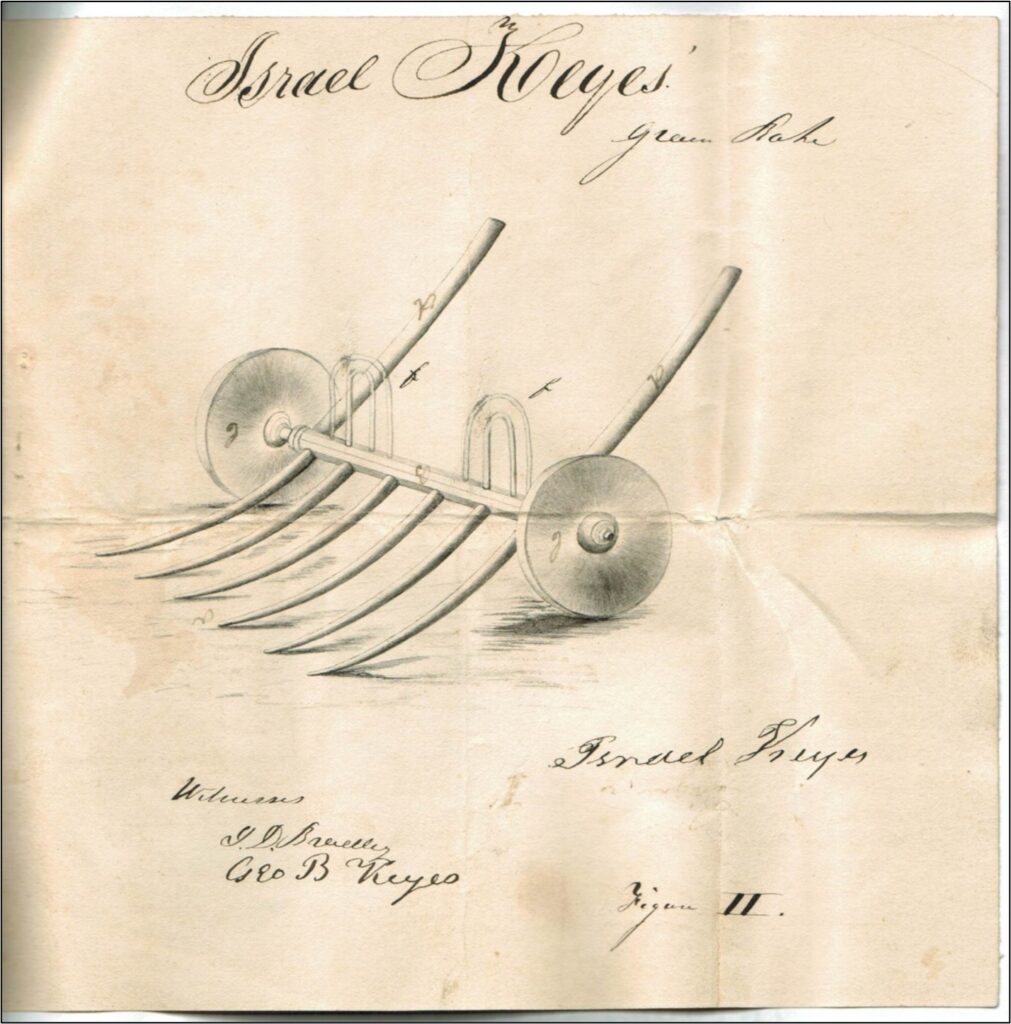
The patent states: “The object attempted in my invention is to gather the grain easily and quickly into quantities fit for bundles, and to hold it when thus gathered at a convenient height from the ground until it can be bound, thus relieving the labour [sic] by diminishing the necessity of stooping and preventing also the wounding of his hands upon the stubble.”
Not all of his inventions are recorded, but the following agreement with a neighbor describes another of them. Dated Aug. 15 1868, the agreement reads:
‘Israel Keyes of the first part claims to have originated a paddle wheel with the following improvements, viz. – a spiral shank turned by the collar which is moved by means of an eccentric ring in said spiral shank. I, George Houghton, to get ½ interest when patent is obtained, to make 2 models at my expense and pay any necessary expenses for taking out patents and will also use all necessary exertions to introduce wheel into practical use, signed George Houghton and Israel Keyes’.
A manuscript is in existence which was written by Keyes on the subject of air pressure and air draughts. Israel Keyes’ brother, Judge Asa Keyes, also received a patent in 1850 for a steam slate cutting machine that was used in a slate quarry in Guilford.